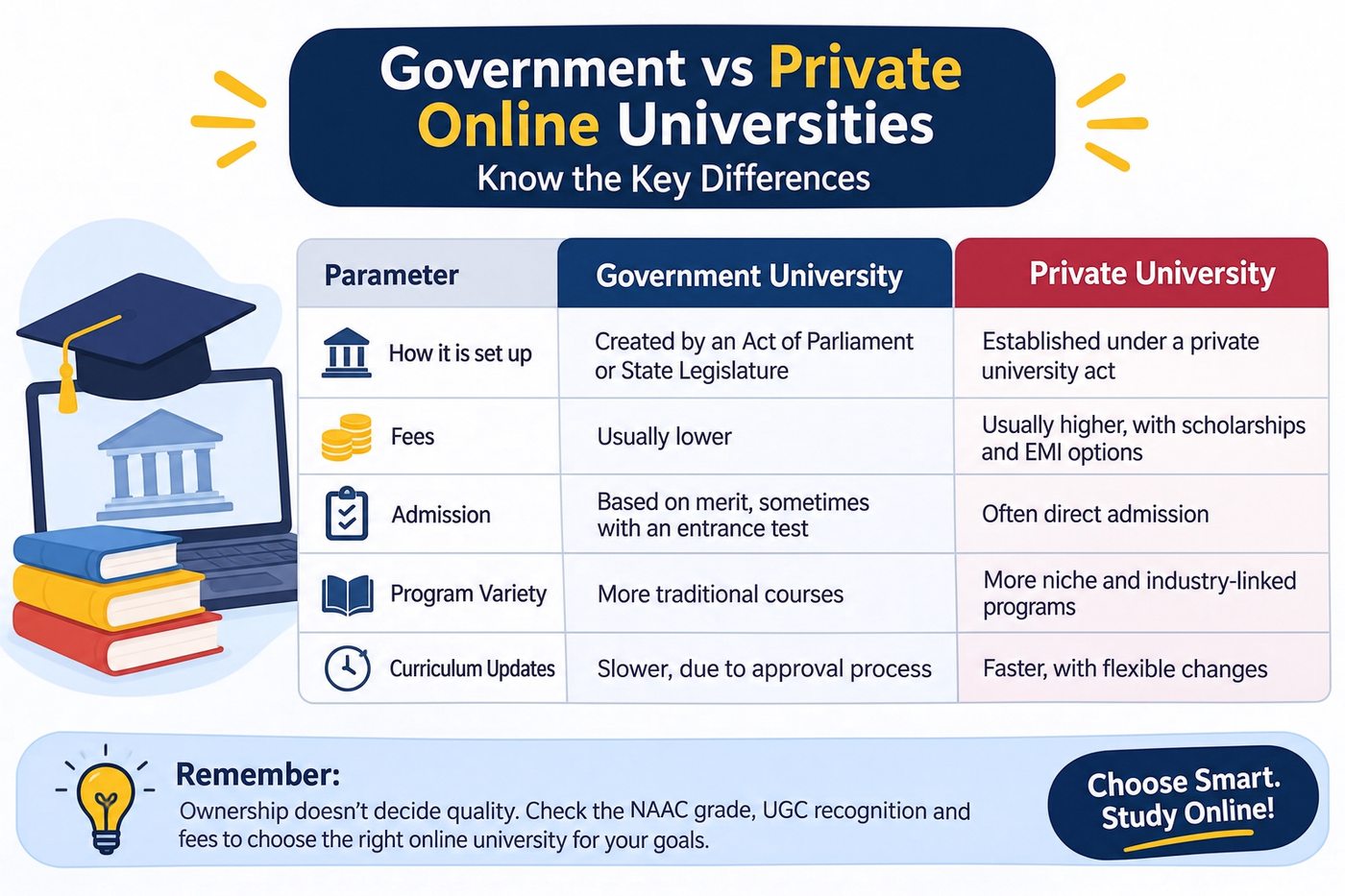
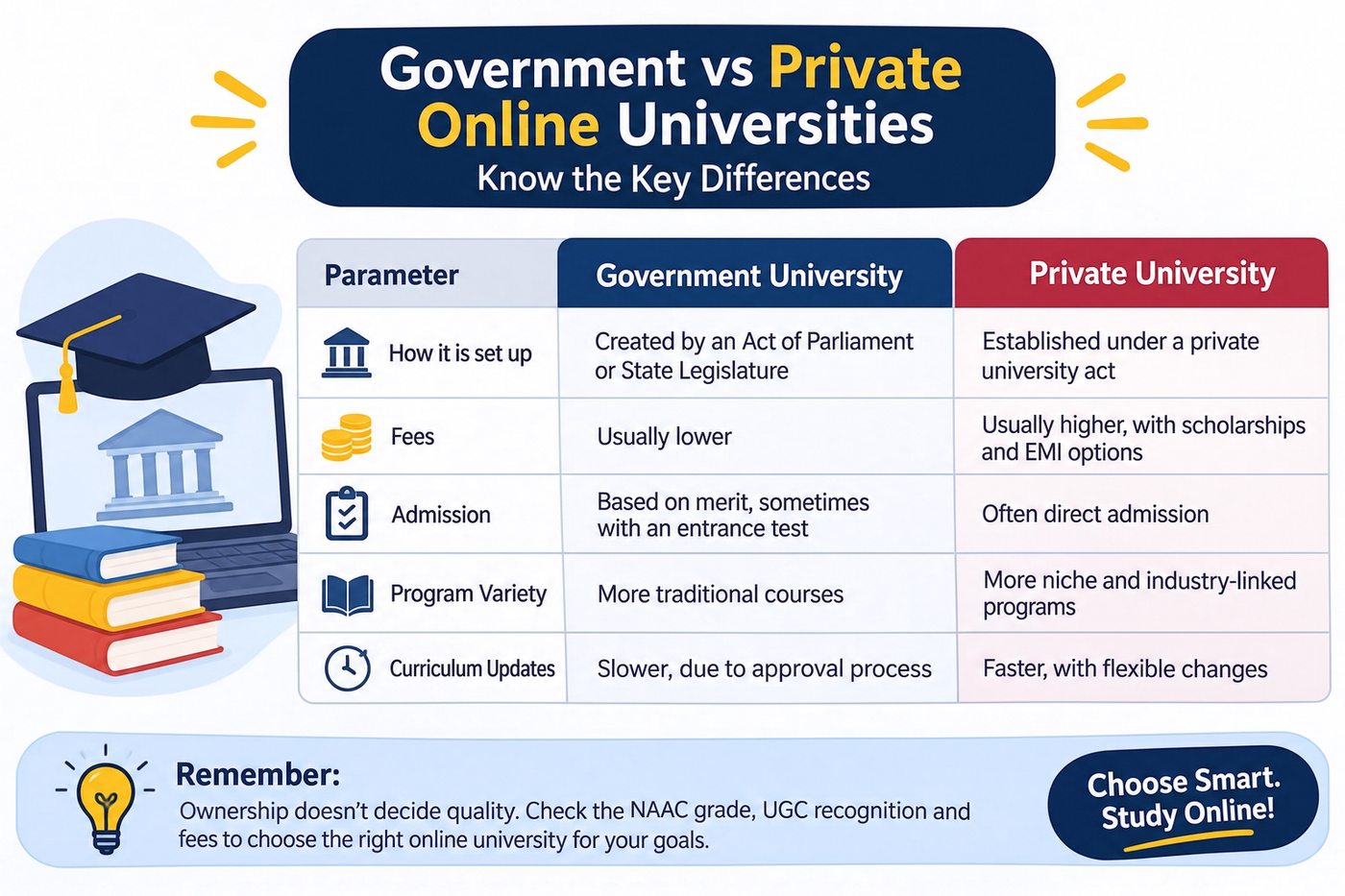
Parameter | Government university | Private university |
How it is set up | Created by an Act of Parliament or a State Legislature | Created under a state or central private university act |
Funding | Public money from the central or state government, along with student fees | Mostly tuition fees, along with trust or private investment |
Fees | Usually lower | Usually higher, though scholarships and EMI plans can reduce the gap |
Admission | Often based on your marks in the qualifying exam, and some programs may ask for an entrance test | Usually direct admission once you meet the eligibility |
Program variety | More traditional and core subject programs | More niche and industry-linked specialisations |
How fast the curriculum is updated | Slower, as changes pass through several approval levels | Faster, as the university’s own boards can approve changes quickly |
These are general patterns, and individual universities can differ. A government university can update its syllabus quickly, and a private one can be slow. Ownership alone does not decide quality, so the approvals, grades, fees, and recognition of the university are also as important as the label.
How Do Fees Compare for Online Programs?
The government option is not necessarily cheaper online because there are many private universities providing scholarships and EMI schemes. However, the government option provides a definite figure. The following is an estimate of total program costs.
Program | Government fee range | Private fee range |
Online MBA | About ₹1,02,000 | ₹65,500 to ₹1.8 lakh |
Online MCA | About ₹76,647 | From about ₹1.2 lakh |
Online BBA | About ₹72,661 | ₹66,000 to ₹1.4 lakh |
Online MA or MCom | About ₹60,000 | ₹33,000 to ₹1.7 lakh |
Check out the private fees, and you will be able to understand the extent of the variation here, from ₹33,000 to ₹1.8 lakh. The government fees range narrowly, and not one of these courses costs more than ₹1.02 lakh.
What the Fee Includes: Find out if the amount includes tuition, examination, and LMS fees. Since government universities have only one program fee, it becomes easier to know what your fee includes.
Other Fees to be Enquired About: Before paying the first instalment, know more about additional fees like registration, re-exam, and convocation fees.
Scholarships and EMI schemes: Many private colleges have scholarships and EMI schemes. Government colleges allow you to make payments semester-wise in small sums, for instance, ₹12,000 to ₹25,500 per semester. Therefore, you may not require any kind of loan.
How Does NAAC Grade Compare Between Government and Private Universities?
The NAAC is a body that evaluates the quality of a university and grades it. The grade is applicable to the university only; thus, a government university and a private university can both have a good grade.
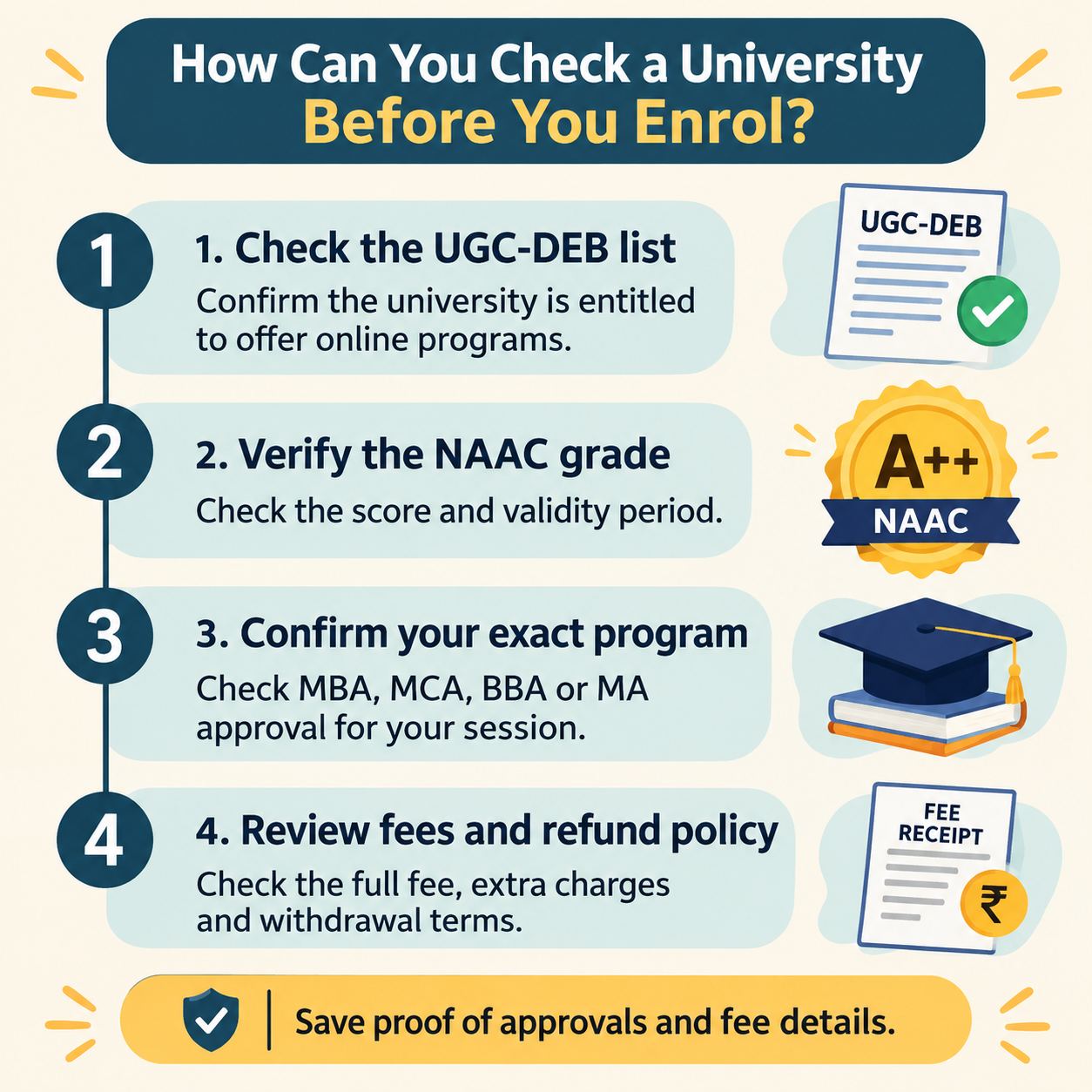
What the Grade Means: NAAC awards grades ranging from A++ to C, where A++ is the highest. This grade depends on the score. Scores ranging from 3.51 to 4 are awarded A++, while scores ranging from 3.26 to 3.5 are awarded an A+. An institution with scores of 1.50 or below is given grade D; thus, it is not accredited. You can also check the list of NAAC-accredited online universities offering online programs to compare institutions based on accreditation and affordability.
Validity Period for Grade: The validity period for NAAC grade is five years. After this, the university needs to apply again for its grade. Hence, it is important to check the validity period of the grade.
Comparison between NAAC & NIRF: NAAC evaluates universities according to common criteria and grades them. On the other hand, the NIRF ranking is an annual ranking of universities in comparison with each other. Universities can receive an excellent NAAC grade but no ranking, or may possess both at the same time.
Check out the latest NAAC Grade: Do a search for the name of the university along with the grade and its score. Please keep in mind that NAAC does not include any distance education unit.
UGC lets a university offer online programs if it has a NAAC score of 3.26 or above out of 4, which means A+ or A++, or if it ranks in the NIRF top 100 universities.
Is the Recognition the Same for Government and Private Online Degrees?
Of course, the recognition is the same if both the university and the program you are choosing have the necessary approvals. The online degree is equivalent to an offline degree in terms of recognition according to UGC, whether the university is government or private.
UGC DEB Approval: UGC DEB is the department of UGC that enables the university to offer online degrees. The approval comes on the basis of the program, meaning a university may be approved for its MBA but not for BBA. Please do check your exact program.
AICTE for MBA & MCA: AICTE deals with management and technical education. In case of an online MBA and MCA, AICTE approval is also required, based on the kind of university.
Validity for Government Jobs: The recruiters check for recognition and not the ownership of the university. A degree from a UGC DEB approved university is always considered equal to a normal degree for government jobs. However, each government job application has its own set of criteria; hence, one should read the eligibility criteria.
Validity for Higher Education and Foreign Countries: In India, an online degree is valid for higher education, just like any other degree. However, in foreign countries, it varies from country to country and from university to university. Therefore, it is advised that before getting enrolled, one should inquire about its validity.
One must confirm whether the university and its online degree programs are UGC entitled before paying any fee.
Choose a Recognised Online Degree from Kurukshetra University Comparing public and private online universities? Look beyond fees and compare university recognition, NAAC grades, and learning flexibility before making a decision. Kurukshetra University Online offers UGC-entitled programs such as Online MCA, MBA, MA, and BBA, backed by its NAAC A++ accreditation. Why consider KUK Online? Study at a public university with a long academic history. Choose from undergraduate and postgraduate online programs. Benefit from a flexible learning format. Explore affordable higher education options. Balance your studies with work and other commitments.
Explore Online Programs at Kurukshetra University to check available courses, eligibility, and fees before applying. |
Which Is Better for You: Government vs Private Online Universities?
The better choice depends on the program approval, the fees, the NAAC grade, and the support you get, not on who owns the university. Here is how it plays out for different situations.
Your situation | Better fit | Why |
Tight budget | Either, compare the total fee | Government fees are usually lower and easy to plan, but some private universities cost less and offer scholarships and EMI. Add up the full program fee for each one. |
Working professional | Either | What helps you is flexibility, like recorded lectures, exam dates and support. Check these for each university, because the label does not tell you. |
Aiming for government jobs | Either, if the program is UGC DEB approved | Recruiters look at recognition, not ownership. Read the job notice for its own eligibility rules. |
Wants newer specialisations | Often private | Private universities tend to update their curriculum and add niche specialisations faster. A government university may still offer what you want, so check the program list. |
Wants placement support | Often private | Many private universities run dedicated career and placement services. Government universities may offer less structured support. Ask what you get in writing before you pay. |
Notice that most rows say either. That is the honest answer, because approval, grade, and fees matter more than the type of university. Use this as a guide and always check the details of the university you are looking at.
What Myths Should You Ignore About Government vs Private Online Universities?
Most doubts come from partially correct beliefs; here are four such beliefs and what is actually true.
Government Is Always Better: The government has a good history, and it offers low fees; however, that does not mean that the government program is always better than others. Some private universities have a good NAAC grade and also offer lower fees.
Private Degrees Are Not Valid for Government Jobs: Recruitment is based on whether your degree is recognized, not on the ownership of the university. Online degrees from any university that is approved by UGC DEB will be treated in the same way as any other degree. But still, check the eligibility criteria of each advertisement.
Online Degrees Aren’t Real Degrees: According to UGC, a valid online degree program is the same as any other degree program. The criteria for this are that the university offering and the degree program should have the necessary approval, which can be checked from the UGC DEB list before applying.
Government Universities Do Not Offer Online Programs: Most of them do. There are both state and central universities listed on the UGC DEB list along with the private universities, and they offer popular courses such as MBA, MCA, BBA, MA, and MCom through online mode.
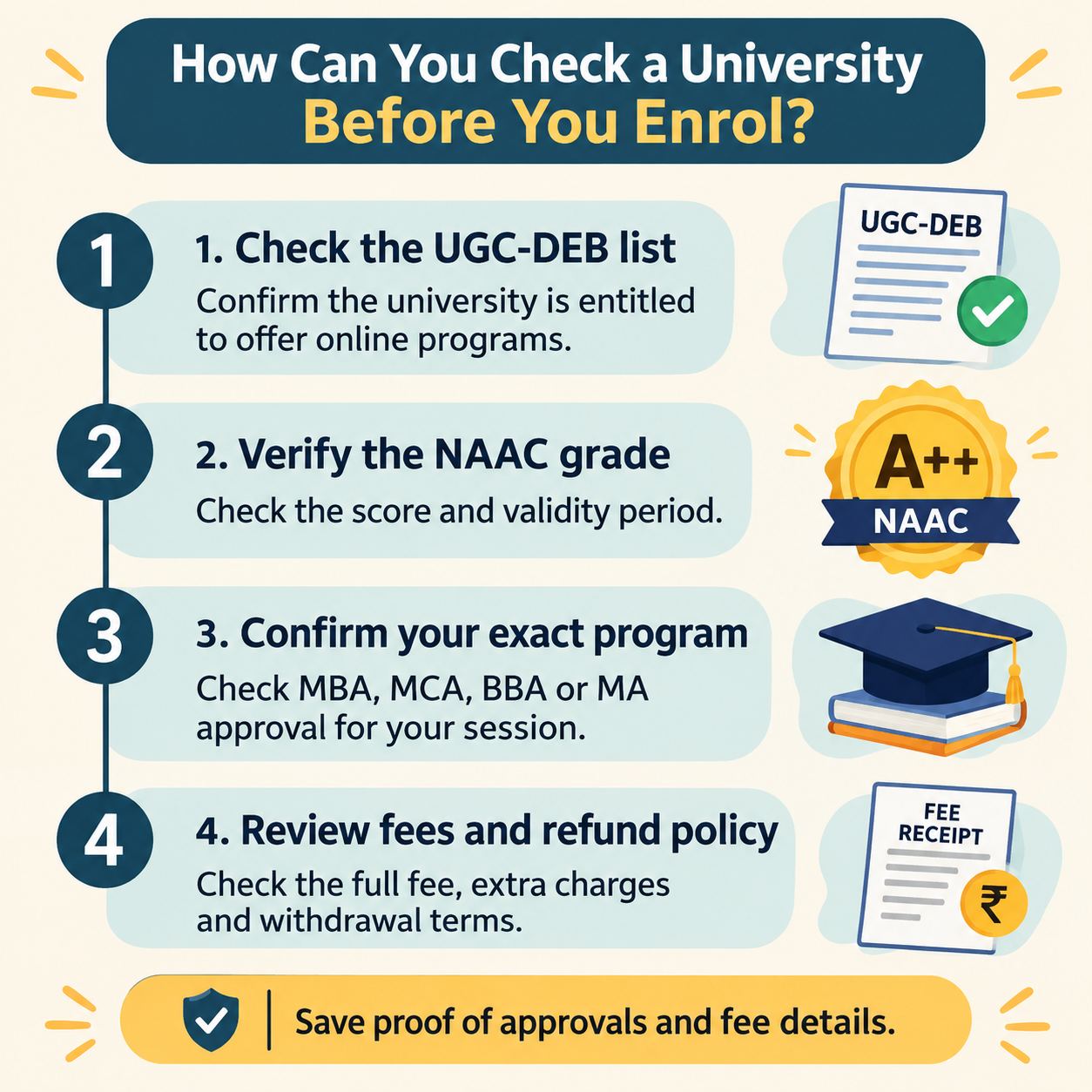
How Can You Check a University Before You Enrol?
It will take about ten minutes, and all you need is a phone/laptop. These are the four simple steps.